











Key Takeaways
- Dynamic Precision Tool & Manufacturing supports prototype and short-run CNC work from its Troy, Michigan, facility.
- Its listed capabilities include 4-axis milling, 5-axis turning, live tooling, bar feeding, grinding, and wire EDM.
- The shop lists CNC tolerances down to 0.0005 inches, with final results dependent on part design, material, process, and inspection requirements.
- Inspection resources include CMM equipment, optical comparators, profilometers, air gages, bore gages, height gages, and surface plates.
- A complete drawing package, material specifications, quantities, a tolerance plan, and a delivery target can support a more useful quotation.
What Should Manufacturers Look for When Requesting CNC Machining?
Choosing a machining partner means matching the supplier to the part, not simply finding a shop with CNC equipment. Geometry, material, tolerance, production quantity, inspection needs, and required delivery date all affect whether a project is a good fit. Manufacturers preparing a CNC machining Michigan request should begin by confirming that the provider can evaluate the complete technical and scheduling requirements.
Dynamic Precision Tool & Manufacturing is a precision machining provider based in Troy, Michigan, with more than 30 years of operating experience. The company focuses on prototypes through short production runs, which can be valuable for product development, replacement components, fixtures, critical assemblies, and limited-volume production parts. Its listed typical lead time is four to six weeks, with rush service available when project conditions allow.
Why Does Dynamic Precision Tool & Manufacturing Fit Tight-Tolerance Work?
The company lists CNC machining tolerances down to 0.0005 inches. For a customer, that figure is a useful starting point, but it is not a blanket promise for every feature. Achievable tolerance depends on the component’s geometry, datum strategy, material stability, machine setup, cutting process, surface requirements, and measurement method.
Its published capacity is designed for a broad range of precision work. Milling capacity extends to parts up to 60 inches long, 30 inches wide, and 30 inches high. Turning capacity reaches 28 inches in diameter and 48 inches long. The shop also lists 4-axis milling, 5-axis turning, live tooling, and up to seven cutting axes on compatible turning work, helping reduce setups for suitable parts.
How Are CNC Milling and Turning Used Together?
CNC machining is not one process. Milling is generally suited to prismatic shapes, pockets, faces, drilled holes, and complex profiles. Turning is commonly selected for round or rotational components such as shafts, hubs, sleeves, threaded bodies, and precision housings. The right routing depends on the part’s features and inspection plan.
CNC Milling Operations
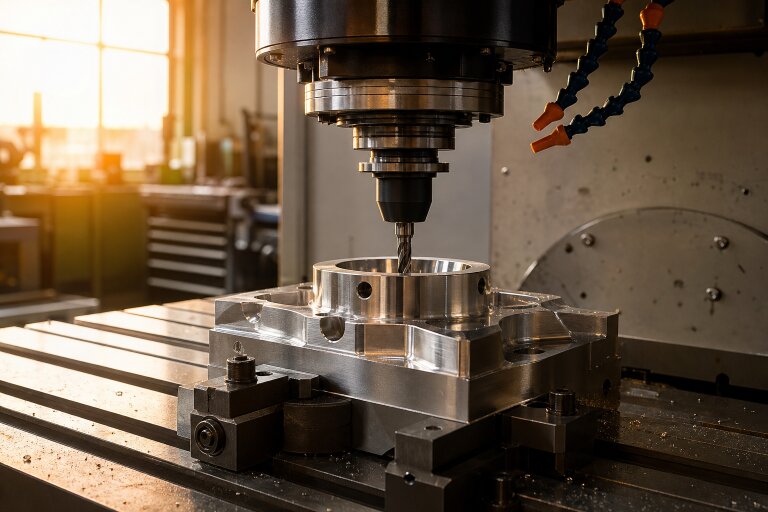
Dynamic Precision Tool & Manufacturing lists milling, drilling, boring, pocketing, profiling, reaming, counterboring, countersinking, thread milling, facing, and parting or cutting. These processes can support precision components, fixtures, production parts, specialty machine components, and assemblies that require accurately located features.
CNC Turning Operations
Its turning services include contour, form, taper, straight, and hard turning, as well as internal and external threading, tapping, and knurling. Live tooling can add secondary features such as cross-holes, flats, or milled details to appropriate turned parts.
How Does the Shop Verify Part Quality?
Producing a part is only one part of the job. Proving that it meets the drawing is equally important. Dynamic Precision Tool & Manufacturing lists coordinate measuring machines, optical comparators, profilometers, height gages, air gages, dial bore gages, and surface plates among its inspection resources. Those tools can support dimensional checks, bore measurements, profile reviews, surface evaluations, and visual inspections.
The company also lists blueprints and job routers as quality documentation resources. Measurement feedback matters because machining quality is easier to manage when information reaches the process in time to guide decisions.
Which Materials Can Dynamic Precision Tool & Manufacturing Machine Process?
Material selection changes the machining strategy. It influences tool wear, cutting speed, heat management, surface finish, dimensional movement, and inspection planning. The company lists common metals, including steel, stainless steel, aluminum, brass, bronze, and copper. It also lists titanium, tungsten, molybdenum, Nitronic 60, Inconel, Hastelloy, Monel, and nickel alloys.
For non-metal parts, listed materials include nylon, Delrin, ABS, Lexan, Vespel, acrylic, polypropylene, UHMW, PVC, PEEK, and unsintered ceramic. When requesting a quote, customers should identify the exact material grade, temper or heat-treatment condition, finish requirements, certifications, and any special handling instructions.
Can the Shop Support Demanding Industries?
Dynamic Precision Tool & Manufacturing identifies aerospace, defense, automotive, medical, technology, and oilfield technology as its industry focuses. Experience in these fields can matter because documentation, traceability, material control, inspection, and delivery expectations may differ substantially from one project to another.
One published example is a precision drill-and-ream fixture for military and defense work. The project involved one D2 tool-steel fixture with a 28-inch outside diameter and 2.31-inch height, including squareness tolerances as close as 0.0002 inches and a six-week turnaround. This case study demonstrates performance on that specific fixture, not a guarantee for every future order.
How Do Grinding and Wire EDM Add Value?
In addition to CNC machining, the company offers surface grinding, ID and OD grinding, form grinding, jig grinding, and wire EDM. Grinding may be used when a part needs close dimensional control or a specific finish after machining. Wire EDM can be useful for intricate profiles, narrow slots, hard materials, and features that are difficult to reach with conventional cutting tools.
When multiple processes can be coordinated by one established provider, customers may benefit from fewer handoffs and clearer process communication. However, customers should confirm the proposed manufacturing route in the quotation, since not every project will require or be completed using the same combination of operations.
Why Is Measurement Science Important in Precision Machining?
Precision is the result of a controlled system, not only the CNC machine. Before production begins, customers should align on critical tolerances, surface roughness, inspection points, revision levels, material certifications, packaging, and delivery expectations. NIST’s research on manufacturing performance measurement reinforces the broader value of measuring and analyzing operational performance to support improvement.
What Should Be Included in a CNC Machining Request?
- Current 2D drawings and 3D CAD files.
- Material type, grade, condition, and required certifications.
- Quantity and whether the job is a prototype or a short production run.
- Critical dimensions, tolerance callouts, finish, hardness, coating, and heat-treatment requirements.
- Inspection reports, documentation needs, target delivery date, shipping location, and any rush-service request.
How Should Manufacturers Compare Machining Options?
Use a practical evaluation process by assessing whether the shop can meet requirements for size, geometry, material, tolerance, and volume. Verify inspection tools and documentation, and discuss machining, grinding, wire EDM, fixturing, and tooling coordination. Clarify lead times, revision control, and the main point of contact. For precision prototypes, critical parts, or short runs, compare Dynamic Precision Tool & Manufacturing’s capabilities with the project needs. Provide drawings, materials, quantities, tolerances, inspection details, and delivery information to facilitate a more accurate quotation review.
Conclusion
Selecting the right CNC machining partner requires more than comparing equipment. Careful evaluation of capabilities, materials, tolerances, inspection resources, and production capacity helps ensure the supplier aligns with project requirements. Providing complete technical information upfront supports more accurate quotations, smoother communication, and better outcomes for prototype and short-run manufacturing projects.