









Denver-area building managers need filter schedules that reflect real operating conditions, not just a recurring calendar alert. For teams that need local help with recurring inspections, installation, removal, or disposal, filter change services Denver CO are available through Air Force Filter and Supply. The company provides commercial filtration products and professional filter services for Greater Denver and Colorado Springs, with a broad inventory of pleated, bag, pre-filter, and custom-sized options.
A consistent filter program helps protect air-handling equipment from particle buildup and supports cleaner recirculating air. It also gives facility teams a practical opportunity to spot loose access panels, blocked returns, moisture, coil debris, and other concerns before they become larger maintenance issues.
Why Filter Scheduling Deserves More Attention
Filters work only while air moves through the HVAC system, so their condition depends heavily on runtime and airborne particle load. A quiet office with limited operating hours may have very different needs than a school, fitness center, warehouse, restaurant, retail store, or multi-tenant property.
Good filter maintenance is part of a larger preventive program. The U.S. Department of Energy notes that operations and maintenance best practices can help organizations reduce annual energy costs while improving HVAC performance and equipment life. A filter change alone is not a full system inspection, but it is an important and repeatable maintenance checkpoint.
How Often Should Commercial HVAC Filters Be Changed?
There is no universal replacement interval for every commercial building. Start with regular inspections, then adjust replacement timing according to what technicians find in the field.
- Low-dust offices with moderate occupancy: Inspect monthly and consider replacement every 60 to 90 days.
- Retail stores, schools, and busy public spaces: Inspect monthly and often plan for changes every 30 to 60 days.
- Warehouses, workshops, and areas affected by construction dust: Inspect every two to four weeks and replace when loading or pressure readings indicate it is necessary.
- Healthcare, laboratory, and other sensitive-use spaces: Follow the facility’s documented plan, equipment requirements, and professional guidance.
These are planning ranges, not automatic rules. Manufacturer instructions, the installed filter type, pressure-drop data, and system performance should guide the final interval. The EPA advises replacing filters according to manufacturer recommendations and notes that many are commonly changed every 60 to 90 days, with more frequent changes when they become heavily soiled.
Five Factors That Change the Schedule
- Building use: Gyms, salons, kitchens, workshops, and schools can generate or bring in more particles than a lightly occupied office.
- Outdoor conditions: Denver buildings can encounter spring pollen, windblown dust, nearby construction activity, autumn debris, and periods of wildfire smoke. Each can shorten a filter’s useful life.
- System runtime: A unit that operates for extended hours moves more air through its filters and deserves closer monitoring.
- Occupancy: More occupants generally mean more activity, more particles, and greater ventilation demand.
- Filter design: Thickness, media area, frame construction, and efficiency rating all affect loading characteristics and replacement timing.
How to Tell When a Filter Needs Attention
Visual inspection matters, but it should not be the only test. A filter may look acceptable on one side, while airflow or pressure readings indicate it is nearing the end of its useful service life.
- Dust buildup across much of the filter media.
- Reduced airflow at supply vents or occupant comfort complaints.
- Longer run times, unusual blower noise, or temperature control problems.
- Higher pressure-drop readings where gauges or monitoring equipment are installed.
- Dust around the filter frame can indicate an improper fit or air bypass.
- Moisture damage, collapsed media, odors, or a damaged frame.
Choosing the Right Filter Rating
MERV, or Minimum Efficiency Reporting Value, is a rating used to describe a filter’s particle-capture performance. Higher MERV ratings generally capture more particles, but the highest available rating is not automatically appropriate for every rooftop unit, furnace, or air handler.
A filter that creates more resistance than the fan and filter rack can accommodate may affect airflow. The EPA recommends using the highest-rated filter a system can properly accommodate, and advises consulting an HVAC professional when compatibility is uncertain. A properly sized filter should fit snugly without bending, crushing, or leaving gaps that allow air to bypass the media.
A Simple Commercial Filter Change Process
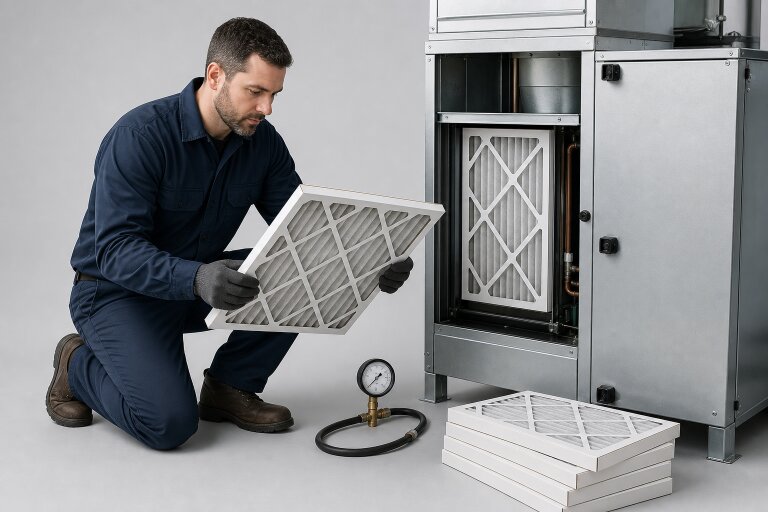
- Map every filter location, including rooftop units, ceiling returns, air handlers, and tenant spaces.
- Verify the exact length, width, depth, quantity, MERV rating, and frame style before ordering.
- Inspect the existing filter for loading, moisture, damage, odors, and bypass before removal.
- Install the new filter in the correct airflow direction and seat it evenly in the rack.
- Check surrounding equipment for loose panels, unusual sounds, blocked returns, and visible coil contamination.
- Document the date, technician, product installed, pressure reading (if available), and any needed follow-up work.
- Use those records to revise the next inspection date based on actual conditions.
Build an Inventory Before It Becomes an Emergency
A spreadsheet or digital asset list can prevent missed units, incorrect orders, and last-minute filter purchases. Create one entry for each unit or filter bank, including the equipment ID, building location, access instructions, filter dimensions, MERV rating, quantity per change, last replacement date, next inspection date, and notes on ladders, roof access, or tenant coordination.
Seasonal Planning for Colorado Buildings
Review filters before heavy cooling and heating periods, then increase inspections when local conditions justify it. Spring pollen and dust can affect loading, summer cooling may increase runtime, autumn debris can affect outdoor equipment areas, and winter heating can change operating patterns. During smoke events, inspect filters more closely and have a qualified HVAC professional confirm any changes to outside-air or recirculation settings.
Common Filter Program Mistakes
- Replacing every filter on the same date without checking the actual condition.
- Ordering based on appearance instead of verified dimensions and depth.
- Upgrading to a higher MERV rating without reviewing system compatibility.
- Leaving gaps around the frame or installing the filter backward.
- Tracking purchases, but not documenting the location of the equipment where filters were installed.
- Overlooking hard-to-reach rooftop units, returns above ceilings, or vacant tenant spaces.
Questions Building Managers Often Ask
Can a commercial filter last longer than 90 days?
It can be used in a low-load environment, but the decision should be based on manufacturer guidance, filter condition, pressure-drop readings, and equipment performance rather than the calendar alone.
Should every building use MERV 13 filters?
No. MERV 13 may be appropriate for many systems, but equipment, fan capacity, filter slot, and maintenance plan must be considered before changing the rating.
What records should be kept?
Keep filter sizes, ratings, quantities, replacement dates, equipment locations, technician notes, disposal details, and available pressure-drop readings. These records make budgeting and schedule adjustments much easier.
Final Checklist for a Better Filter Program
- Inventory every filter location.
- Confirm sizes and ratings before ordering.
- Set monthly inspection reminders.
- Use shorter intervals in dusty, high-occupancy, or high-runtime spaces.
- Verify system compatibility before increasing filter efficiency.
- Install filters in the correct direction and eliminate bypass gaps.
- Document every change and related HVAC concern.
- Review the entire schedule at least twice each year.
A reliable commercial HVAC filter program combines a clear starting schedule with regular observation. For Denver and Colorado Springs properties, accurate records, proper installation, and seasonal adjustments can help maintenance teams avoid missed changes and respond more confidently to changing building conditions.