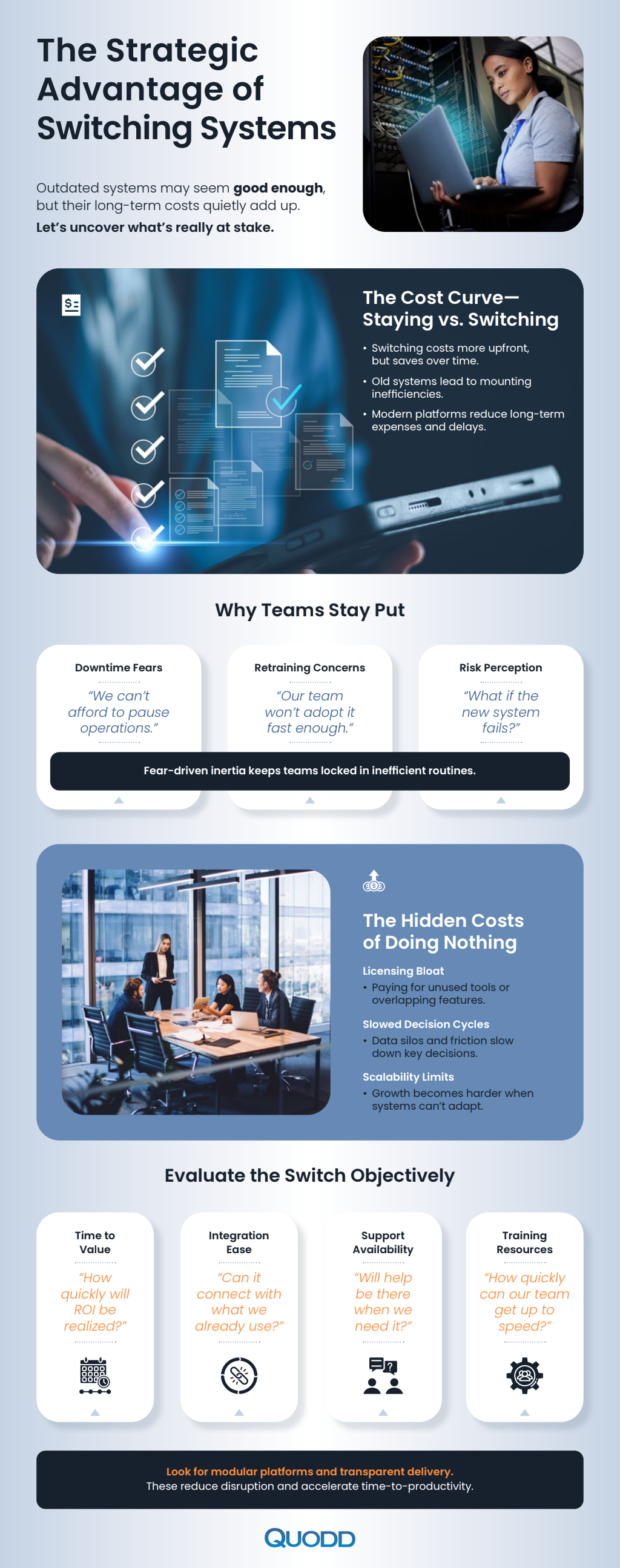












Organizations frequently reach a point where they must decide whether to continue relying on systems that feel familiar or invest in new technology that promises greater efficiency. At first, sticking with what you know may appear to be the practical path. It avoids short-term complications, training time, and the potential roadblocks of system integration. However, the comfort of staying put often conceals long-term inefficiencies that slowly reduce performance, limit adaptability, and drain value.
Legacy platforms can give the impression of stability. They function day to day, employees are comfortable using them, and the routines built around them feel reliable. But this sense of reliability can be misleading. As time passes, these systems become more difficult to maintain. Support from vendors may decrease or disappear entirely. Integrations with newer tools become more challenging. What once helped your team move faster may now be slowing things down, creating data silos and stalling business agility.
The expense of clinging to outdated software grows over time. Teams are forced to patch functionality gaps using extra tools, which often overlap or add complexity. IT resources are spent fixing rather than improving, and users work around limitations instead of solving them. The result is a growing pile of technical debt and a slow erosion of innovation. Even worse, teams may start to lower their expectations, adapting to the system’s limits instead of questioning them. When this happens, opportunities to improve efficiency and collaboration can go unnoticed.
Concerns about switching systems are common. Leaders often worry about the risks involved, such as downtime, a steep learning curve, or the uncertainty of whether the investment will pay off. But modern platforms are built with flexibility and ease of implementation in mind. When change is approached with a clear plan and a focus on outcomes, the transition can be smooth and well worth the effort. Today’s technology vendors offer stronger support, better training, and open systems that are easier to integrate with existing tools.
Upgrading opens the door to more cohesive operations. It allows businesses to centralize data, reduce manual work, and make smarter, faster decisions. New systems are designed to adapt to change, making it easier to respond to shifts in the market, meet new compliance requirements, or take advantage of growth opportunities. With real-time insights and more efficient workflows, teams can move with greater clarity and purpose.
The effort involved in updating systems is short-lived. The long-term cost of not evolving can be harder to see until it has already taken a toll. Delays in adopting modern tools often result in missed opportunities and added strain on both people and infrastructure.
Adopting new systems is not just about upgrading technology. It reflects a broader shift toward aligning tools with strategic priorities. This change requires leadership support, coordinated planning, and a commitment to long-term improvement. Organizations that view system upgrades as business investments—not just technical projects—are more likely to see lasting returns.
Being ready for the future means having the tools and mindset to adapt. Choosing to evolve early, rather than waiting until change is unavoidable, puts organizations in a stronger position to succeed. To dive deeper into the long-term impacts of legacy systems and how switching unlocks value, explore the full visual breakdown in the supporting infographic from Quodd, a provider of global financial data API.