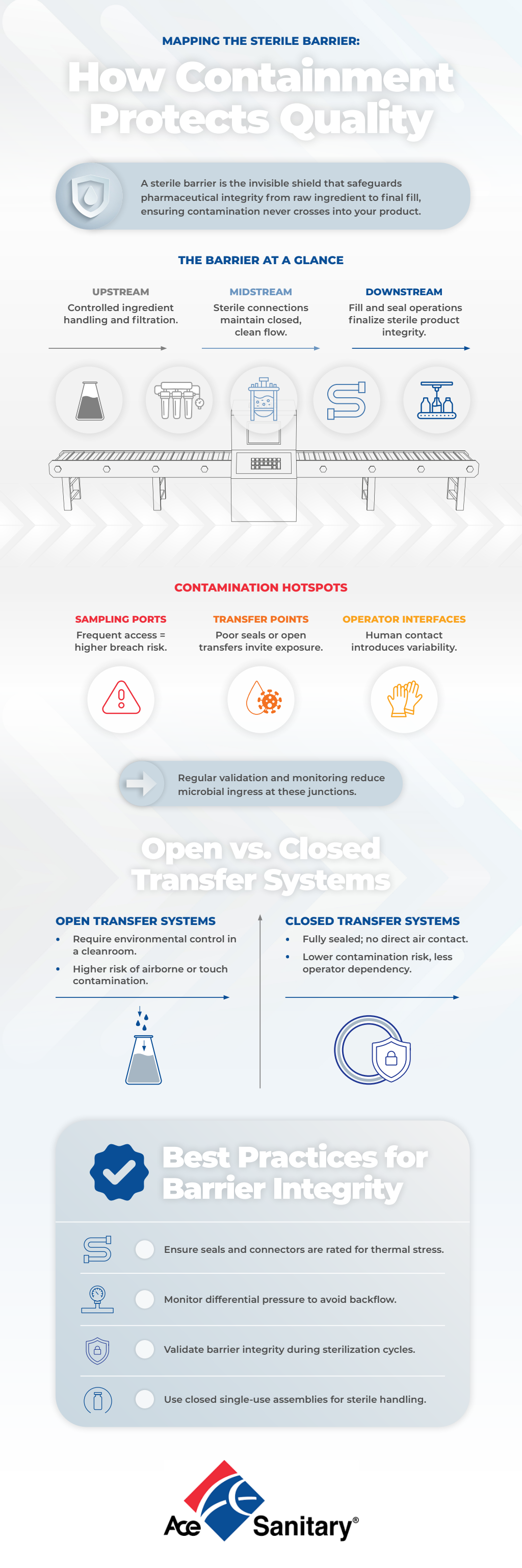












In sanitary processing, sterility is not a single checkpoint in production. It is a continuous responsibility that spans every stage, from handling ingredients to sealing the final package. Containment is the safeguard that upholds this promise. It protects product integrity, supports regulatory compliance, and strengthens the trust customers place in your operations.
Every sanitary process starts with raw materials, long before mixing, filtration, or transfer takes place. This is where the sterile barrier begins. Equipment design, choice of materials, and system layout all influence how effectively the process can resist contamination later on. Components engineered for purity, featuring smooth polished surfaces, minimal dead space, and verified compatibility, help establish a reliable foundation for sterility.
As product moves through the system, the challenges multiply. Transfers, sampling ports, and operator interactions introduce possible points of vulnerability. A strong containment strategy anticipates these areas by limiting open steps and controlling each connection. Consistency is essential. Every time a hose, fitting, or assembly is touched, sterility can either be preserved or compromised. Selecting high-quality components, installing them correctly, and confirming proper alignment all contribute to long-term reliability.
Closed transfer systems add another protective layer by preventing direct exposure between product and the surrounding environment. Unlike open systems that rely heavily on controlled spaces and operator precision, closed systems reduce exposure altogether. By minimizing air contact and limiting manual handling, they decrease variability and support more consistent product quality. They also boost operational efficiency by reducing cleaning requirements and simplifying validation efforts.
Environmental conditions influence barrier strength as well. Pressure changes, temperature shifts, and sterilization cycles can each create stress on seals and connectors. Materials must be chosen for durability and flexibility under these shifting conditions. Routine inspections and maintenance keep the system performing as intended. Visual checks, leak detection, and validation procedures all help identify concerns early and prevent unnecessary downtime.
Containment is not a single component or a standalone device. It is a philosophy woven into every sanitary hose, fitting, and connection that carries product through the process. When each part of the system supports sterility and reliability, the entire operation becomes stronger. Maintaining a dependable sterile barrier is not only about preventing contamination. It is about preserving the integrity of what you create and the trust of the people who rely on it.